
We are creative, ambitious and ready for challenges!

Edit Content

About Orbis Systems

Orbis Systems provides quality control solutions, functional testing solutions, components and services for its customers’ R&D, production and after sales needs. Our products and services increase efficiency and performance in our customers’ processes and hence shorten time to market, lower process costs and increase the end customers’ satisfaction.

Contact Info

Konekuja 2, FI-90620, Oulu, Finland

info@orbissystems.eu

Categories
Blogs

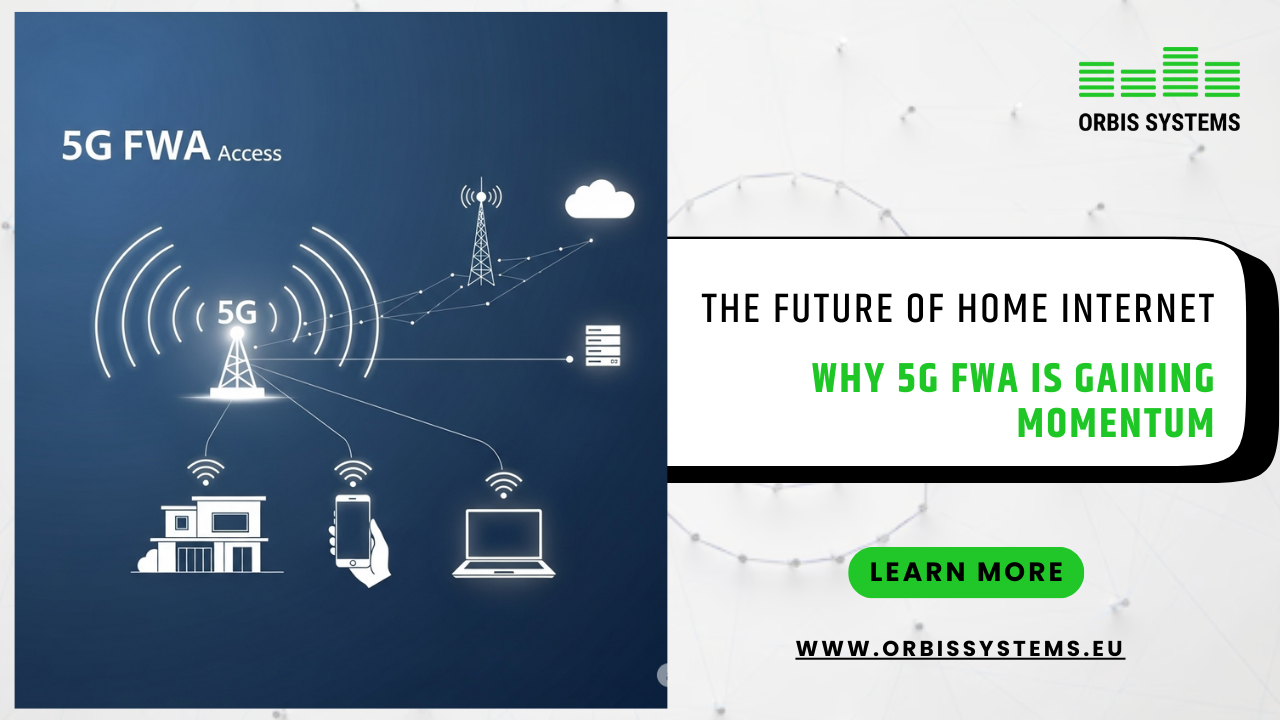
The Future of Home Internet: Why 5G FWA Is Gaining Momentum

Table of Contents

  1. How to Understand Fixed Wireless Access in the 5G Era
  2. Why 5G-Based FWA Wireless Is Gaining Popularity
  3. Role of Antenna FWA 5G in Performance Delivery
  4. Importance of an Antenna Testing Chamber in Network Validation
  5. Moving Forward with 5G FWA
  6. A list of frequently asked questions (FAQs)
Key points

  • The rise of home internet through FWA solutions is a clear sign that people are moving away from traditional broadband. Here are some more in-depth points to remember:
  • 5G will change how people use the internet at home. FWA uses 5G technology to deliver high-speed internet comparable to fiber, especially in areas without cable infrastructure
  • The way the antenna is made is fundamental. How well antenna FWA 5G setups work determines how well networks can handle a lot of traffic.
  • Testing makes sure that everything is working well. An antenna testing chamber lets providers see how well an antenna works.
  • Scalability is essential. FWA is a faster, more flexible, and less expensive way to grow than wired broadband.
  • Businesses are adopting it more quickly. As operators see the benefits for the economy and performance, FWA is becoming a standard part of next-gen internet strategies.

5G Fixed Wireless Access (FWA) is transforming home and enterprise internet by delivering fiber-like speeds without the need for extensive cabling. This makes FWA a powerful alternative in areas where laying fiber is costly or time-consuming, and it’s one of the reasons why FWA is quickly gaining momentum as a future-ready connectivity solution.

Over the past few years, the global demand for high-speed internet has skyrocketed. The rapid growth of the Internet of Things (IoT), smart home devices, streaming services, and remote work has placed heavy pressure on traditional wired broadband networks.

5G-enabled Fixed Wireless Access offers a fast, reliable, and scalable way to deliver broadband services. Its performance is made possible by innovations in advanced 5G antenna technologies such as beamforming, massive MIMO, and dynamic spectrum utilization, which improve signal reach, speed, and stability.

To ensure that these systems perform consistently in real-world deployments, network equipment and customer-premises devices undergo rigorous evaluation in antenna testing environments, such as anechoic chambers. These controlled environments help validate signal strength, coverage patterns, and device interoperability ultimately ensuring a dependable user experience.

How to Understand Fixed Wireless Access in the 5G Era

Fixed Wireless Access (FWA) uses radio signals from cellular base stations to connect to customer premises equipment (CPE). Unlike fiber or DSL, it doesn’t require extensive long-distance cabling, making it a faster and more cost-effective way to deliver broadband connectivity. Inside the home or office, the CPE then distributes the connection via Wi-Fi or Ethernet to user devices.

FWA is especially valuable in areas where laying fiber is too expensive or physically impractical. With 5G radio access technologies, FWA can deliver high-speed, low-latency internet that enables smooth streaming, remote work, IoT applications, and even bandwidth-hungry services like cloud gaming and VR.

While fiber still provides the highest and most consistent performance, 5G FWA offers gigabit-class speeds under the right conditions, often making it comparable to fiber for many everyday applications.

To close the digital divide, operators worldwide are rapidly rolling out FWA as a scalable, flexible, and cost-efficient part of next-generation connectivity strategies.

Why 5G-Based FWA Wireless Is Gaining Popularity

There are both technical and economic reasons why Fixed Wireless Access (FWA) is becoming a leading connectivity choice. Unlike older 4G-based setups, 5G FWA leverages advanced technologies such as massive MIMO, beamforming, and a mix of sub-6 GHz and mmWave spectrum to deliver reliable high-speed broadband.

Key Benefits of 5G FWA

Scalability

Operators can expand coverage and capacity much faster, since they don’t need to dig trenches or lay long stretches of fiber cable.

Speed

5G FWA delivers hundreds of Mbps to gigabit-class speeds, often comparable to fiber for everyday applications like streaming, remote work, and cloud services.

Cost-Effectiveness

Lower infrastructure costs make it possible to bring high-speed internet to rural and suburban areas where fiber rollout would be too expensive.

Flexibility

FWA allows providers to adapt to changing demand, such as in business districts or tourist areas that see seasonal or peak traffic.

Together, these benefits make 5G FWA not just a short-term solution, but a strategic, long-term option for closing the digital divide and enabling next-generation connectivity worldwide.

Role of Antenna FWA 5G in Performance Delivery

The antenna is one of the most critical components of any Fixed Wireless Access (FWA) setup. In 5G FWA systems, antennas provide the wireless link between the network base station and the customer premises equipment (CPE), ensuring strong, reliable, and high-capacity connections.

Modern antenna technologies such as beam steering and phased array designs allow networks to cover larger areas, improve signal focus, and reduce interference. These innovations are key to delivering the consistent speeds and stability that users expect from 5G FWA.

The design, calibration, and testing of antennas have a direct impact on network performance. Factors such as frequency bands, polarization, and radiation patterns influence signal strength, coverage quality, and interference levels. These, in turn, affect the throughput and user-perceived latency of the connection.

By combining advanced design with rigorous testing, 5G FWA antennas play a central role in achieving dependable, high-speed wireless broadband

Importance of an Antenna Testing Chamber in Network Validation

Antenna testing chambers play a critical role in ensuring that 5G Fixed Wireless Access (FWA) networks deliver reliable and consistent performance. These specialized facilities create a controlled environment where antennas can be evaluated without interference or reflections from the outside world.

In these chambers, antennas are validated against international standards through measurements such as gain, efficiency, directivity, and radiation patterns. This testing provides valuable insight into how antennas perform in real-world conditions, helping engineers fine-tune designs for maximum coverage and stability.

Without careful testing and calibration, 5G FWA networks risk experiencing issues such as inconsistent speeds, reduced coverage, and higher interference levels. By eliminating these risks, antenna testing chambers are not only essential tools for engineers but also fundamental to ensuring dependable connectivity for end users.

Moving forward with 5G FWA

The future of connectivity is becoming increasingly wireless, and Fixed Wireless Access (FWA) powered by 5G is at the forefront of this transformation. By combining advanced antenna technologies with rigorous testing in antenna testing chambers, providers can ensure smooth, reliable, and high-performance experiences for end users.

Orbis Systems plays a vital role in this evolution by delivering state-of-the-art testing environments that help 5G innovators validate, optimize, and accelerate their solutions for real-world deployment.

As global demand for faster and more dependable internet continues to grow, 5G FWA is emerging as a cost-effective, scalable, and future-ready option for both homes and businesses. Now is the time to explore how FWA can transform connectivity and keep you ahead in the digital age.

A list of frequently asked questions (FAQs)

Q1: What is 5G Fixed Wireless Access (FWA)?

5G FWA sends high-speed internet to homes and businesses through wireless signals instead of cables.

Q2: How is FWA different from regular broadband?

FWA can deliver gigabit-class speeds comparable to fiber under the right conditions, but fiber still offers greater consistency and capacity

Q3: Why is it essential to test antennas for 5G FWA?

Testing in antenna chambers ensures antennas meet performance standards across frequency bands, supporting reliable coverage and minimizing interference.

Q4: Can FWA take the place of fiber internet completely?

FWA does not entirely replace fiber but complements it by providing connectivity in areas where fiber is too expensive or time-consuming to deploy.

Q5: What kinds of businesses benefit the most from FWA solutions?

FWA’s ability to grow and stay reliable helps more than just homes. For instance, it helps manufacturing, logistics, and smart cities.

Categories
Blogs

Inside Orbis Systems’ Sea Container Testing Chambers: Innovation on a Global Scale

Table of Contents

  1. Redefining 5G OTA Testing with Sea-Container Chambers
  2. Why Sea-Container Testing Matters in the 5G Era
  3. Inside the OTA Performance Test System
  4. Antenna Positioning System: Making Accuracy a Reality
  5. Driving the Future of Wireless Validation with Orbis Systems
  6. Frequently Asked Questions

Key Takeaways

  • Global Mobility- The chambers can be transported and deployed worldwide, allowing companies to avoid the expense of permanent labs and begin testing much sooner.
  • Integrated OTA Test Systems- Each chamber can be equipped with a fully automated OTA performance test system, ensuring consistent, reproducible, and reliable results.
  • Advanced Antenna Positioning- The integrated positioning system enables accurate testing of antenna radiation patterns, beamforming performance, and complex antenna behaviors across both Sub-6 GHz (FR1) and mmWave (FR2) frequency ranges.
  • Modular, Customizable Design- The container chambers can be tailored to specific devices, frequency bands, and testing conditions, providing maximum flexibility for evolving test requirements.
  • Accelerated Product Development- By enabling advanced testing at multiple global locations, Orbis Systems’ solution helps companies shorten development cycles and reduce delays in bringing new wireless products to market.

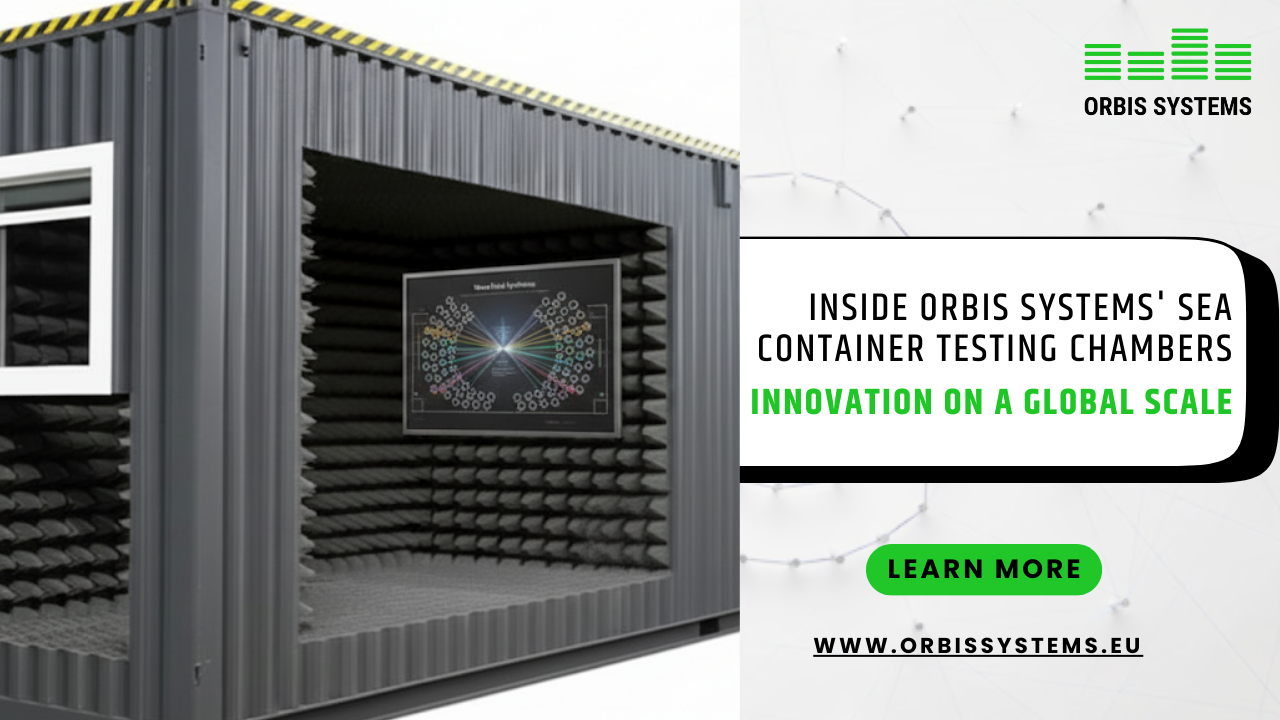
Orbis Systems has transformed standard shipping containers into mobile, RF-shielded 5G OTA chambers. Designed for both Sub-6 GHz and mmWave device validation, these modular chambers integrate advanced OTA performance systems with precision antenna positioning and remote automation. The result is laboratory-grade testing accuracy combined with the flexibility to deploy and operate anywhere in the world.

Redefining 5G OTA Testing with Sea-Container Chambers

With the rapid growth of the telecommunications industry, ensuring wireless devices are tested in a consistent and controlled environment has become a top priority. Orbis Systems addresses this challenge by integrating advanced 5G OTA (Over-the-Air) test chambers into standard sea containers.

These mobile chambers are fully RF-shielded, providing a controlled environment that prevents external interference and ensures reliable measurements. Designed for fast deployment in outdoor or remote locations, they enable businesses worldwide to test 5G and IoT devices with speed, accuracy, and flexibility.

Why Sea-Container Testing Matters in the 5G Era

Manufacturers, research centers, and network operators face growing pressure to deliver new devices and accelerate 5G rollouts. Traditional OTA test labs, while essential, are expensive and time-intensive to build. Orbis Systems addresses this challenge with sea-container-based testing chambers that provide a portable and rapidly deployable alternative.

Designed for fast setup, these chambers allow organizations to expand test capacity or relocate facilities without starting from scratch. This flexibility enables next-generation devices—from smartphones to automotive systems—to be tested closer to manufacturing sites or R&D hubs, reducing both cost and time to market.

Inside the OTA Performance Test System

Each chamber can be equipped with a complete OTA (Over-the-Air) performance test system. This setup includes an RF-shielded enclosure, high-precision measurement antennas, device holders with positioning capabilities, and a software control platform. By automating test procedures, the system minimizes human intervention and ensures consistent, repeatable, and reliable results.

One of the advanced features of these chambers is the use of Planar Wave Synthesis (PWS). PWS enables the system to create a controlled electromagnetic environment that simulates far-field conditions within a compact test space. This is particularly valuable for 5G, where accurate emulation of real-world signal propagation and beamforming behavior is critical.

A key advantage of the solution is the built-in REST API interface, which allows engineers to control and monitor tests remotely. Whether evaluating signal strength, throughput, or latency, the chambers, powered by automated testing and PWS, deliver precise performance insights that closely reflect real 5G network conditions.

Antenna Positioning System: Making Accuracy a Reality

A standout feature of Orbis Systems’ sea-container chambers is the advanced antenna positioning system, a true 3-axis motion controller. It precisely controls measurement antenna height, radial distance, and polarization/rotation, providing exceptional alignment for antennas and devices under test. Each axis integrates absolute position sensors, ensuring the system retains its alignment even after power interruptions. This eliminates the need for recalibration and saves valuable testing time.

The system also offers real-time position monitoring and control via Ethernet, leveraging a standard REST API interface for seamless automation and test integration. In the demanding scenarios of 5G and mmWave testing, where even minimal angular deviations can skew results, this level of precision and reliability is indispensable.

Driving the Future of Wireless Validation with Orbis Systems

Orbis Systems is redefining wireless testing by combining innovation, mobility, and precision in its sea-container-based 5G OTA chambers. Equipped with integrated OTA performance test systems and advanced antenna positioning, these chambers deliver the essential capabilities companies need to validate modern wireless devices quickly, accurately, and reliably.

Whether for 5G, IoT, or other next-generation technologies, Orbis Systems provides a faster, smarter, and more flexible approach to device testing. Partner with Orbis Systems to accelerate your product development and bring high-performance wireless solutions to market with confidence.

Frequently Asked Questions

1. What is a sea-container-based OTA chamber, and how does it differ from a traditional OTA lab?

A sea-container-based OTA chamber is a fully RF-shielded test environment engineered within a standard shipping container. Unlike fixed OTA labs, these chambers are mobile, modular, and globally deployable. They offer the same laboratory-grade testing conditions but with faster deployment, lower upfront costs, and the flexibility to scale or relocate testing capacity as needed.

2. In what ways does an OTA performance test system enhance 5G device testing?

An OTA (Over-the-Air) performance test system enables engineers to evaluate how devices behave in wireless conditions without using physical cables. For 5G, this includes assessing beamforming, signal coverage, data rates, and latency within controlled environments that replicate real-world network conditions. Integrated automation ensures reproducible, accurate, and efficient test results.

3. An antenna positioning system is crucial in OTA testing. Why?

The antenna positioning system allows the device under test to be rotated and aligned in any direction. This is critical in 5G testing—especially at mmWave frequencies—where signal performance is highly sensitive to angle and orientation. Without precise alignment, measurements can yield inaccurate results that do not represent real-world device behavior.

4. Are these rooms capable of hosting other types of testing besides 5G?

Yes. The chambers are flexible and support Sub-6 GHz and mmWave testing, automotive, and IoT use cases. This positions them as a future-proofed investment choice for businesses that play across several wireless technologies.

5. What are the strengths of sea-container chambers compared to fixed OTA labs?

Conventional OTA labs involve permanent infrastructure, high costs, and lengthy construction times. In contrast, sea-container chambers are more economical, quicker to deploy, and can be relocated as needed. For companies expanding internationally or requiring temporary or distributed test capacity, these mobile chambers provide a more versatile and scalable alternative.